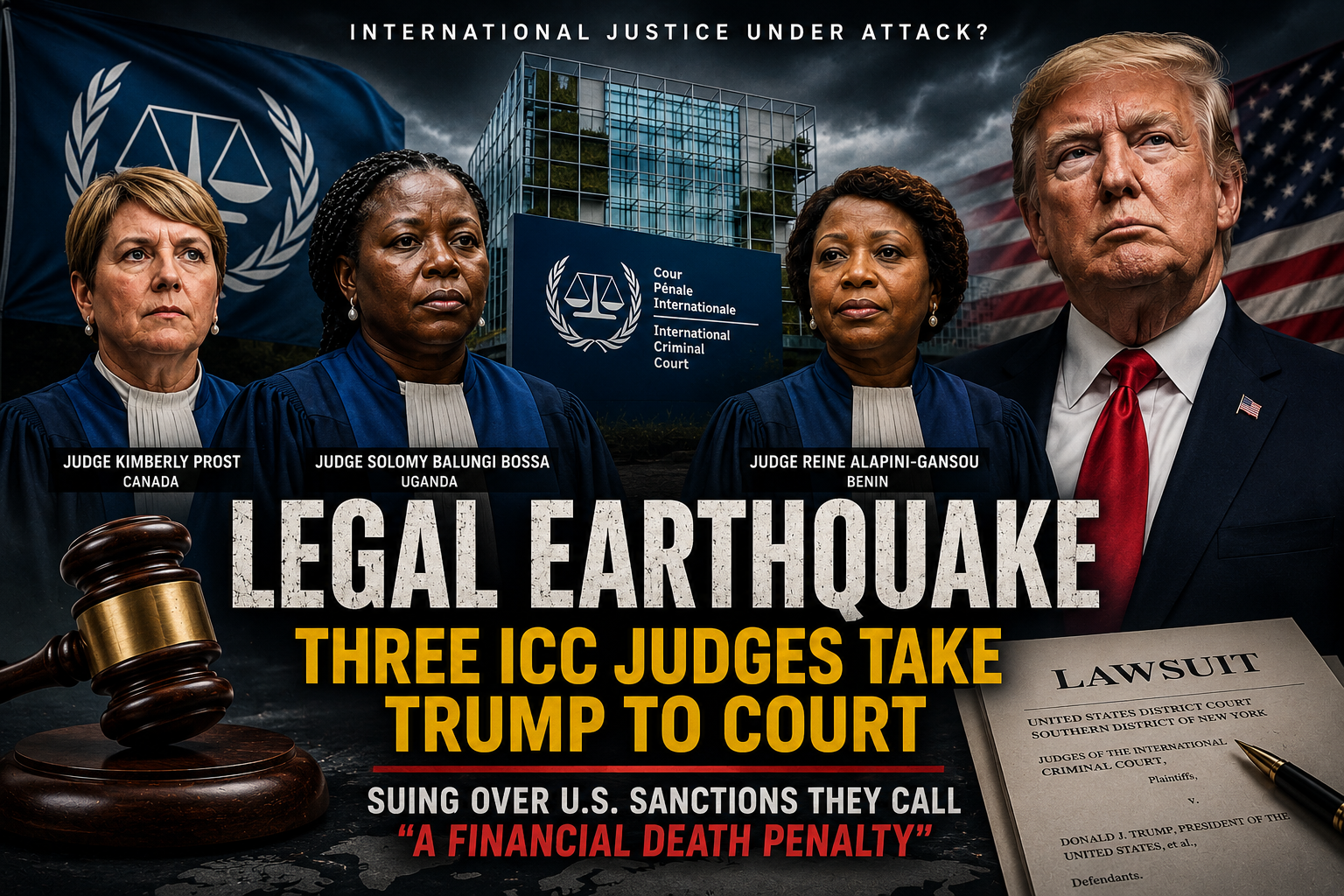
THREE ICC JUDGES SUE TRUMP : CALL U.S. SANCTIONS A “FINANCIAL DEATH PENALTY”
By Publisher Ray Carmen
A major legal battle has erupted between the International Criminal Court and the United States after three ICC judges filed a lawsuit against President Donald Trump and his administration over sanctions imposed in connection with the court’s investigations into Israel and the United States.
The judges argue that the sanctions were designed to punish and intimidate members of the court for carrying out their judicial duties independently.
At the centre of the dispute is the ICC’s decision to issue an arrest warrant for Israeli Prime Minister Benjamin Netanyahu, together with earlier investigations into alleged war crimes involving U.S. personnel in Afghanistan.
The lawsuit was filed in the United States District Court in Manhattan by Judges Kimberly Prost of Canada, Solomy Balungi Bossa of Uganda and Reine Alapini-Gansou of Benin.
According to the legal filing, the sanctions have had devastating personal and professional consequences.
The judges say they have effectively been cut off from much of the international financial system, making it difficult or impossible to use credit cards, access banking services, arrange travel, obtain certain insurance, or use a range of everyday online services.
In the lawsuit they describe the measures as being “tantamount to the financial death penalty.”
They also argue that the sanctions interfere with the independence of the judiciary by attempting to pressure judges over decisions made in the courtroom rather than through political negotiations.
The Trump administration has maintained that the International Criminal Court has no jurisdiction over the United States or Israel, neither of which is a party to the Rome Statute establishing the court. Washington has consistently argued that ICC investigations involving U.S. citizens or Israeli officials exceed the court’s legitimate authority.
Supporters of the sanctions say they are necessary to protect American sovereignty and that of close allies.
Supporters of the ICC, however, argue that judges must be free to decide cases based solely on evidence and international law without fear of political or economic retaliation.
The case is expected to become another landmark chapter in the continuing debate over the balance between national sovereignty and international justice.
Whatever the eventual outcome, the lawsuit highlights the growing tension between one of the world’s leading powers and the world’s permanent international criminal court.
As the legal proceedings unfold, governments, legal scholars and human rights organisations around the world will be watching closely to see how the U.S. courts respond to a challenge that reaches far beyond the individuals involved and touches on the future relationship between international law and national power.