IRAN WAR: WHO REALLY WON?
By Publisher Ray Carmen
War has a strange habit of producing competing versions of victory.
One side claims triumph.
The other side claims success.
And the world is often left trying to decide what actually happened.
Following the recent conflict involving the United States, Israel and Iran, a growing debate has emerged across social media and international media outlets.
Some commentators argue that Iran emerged politically stronger than many expected, while others point to the enormous military and economic costs incurred by all sides.
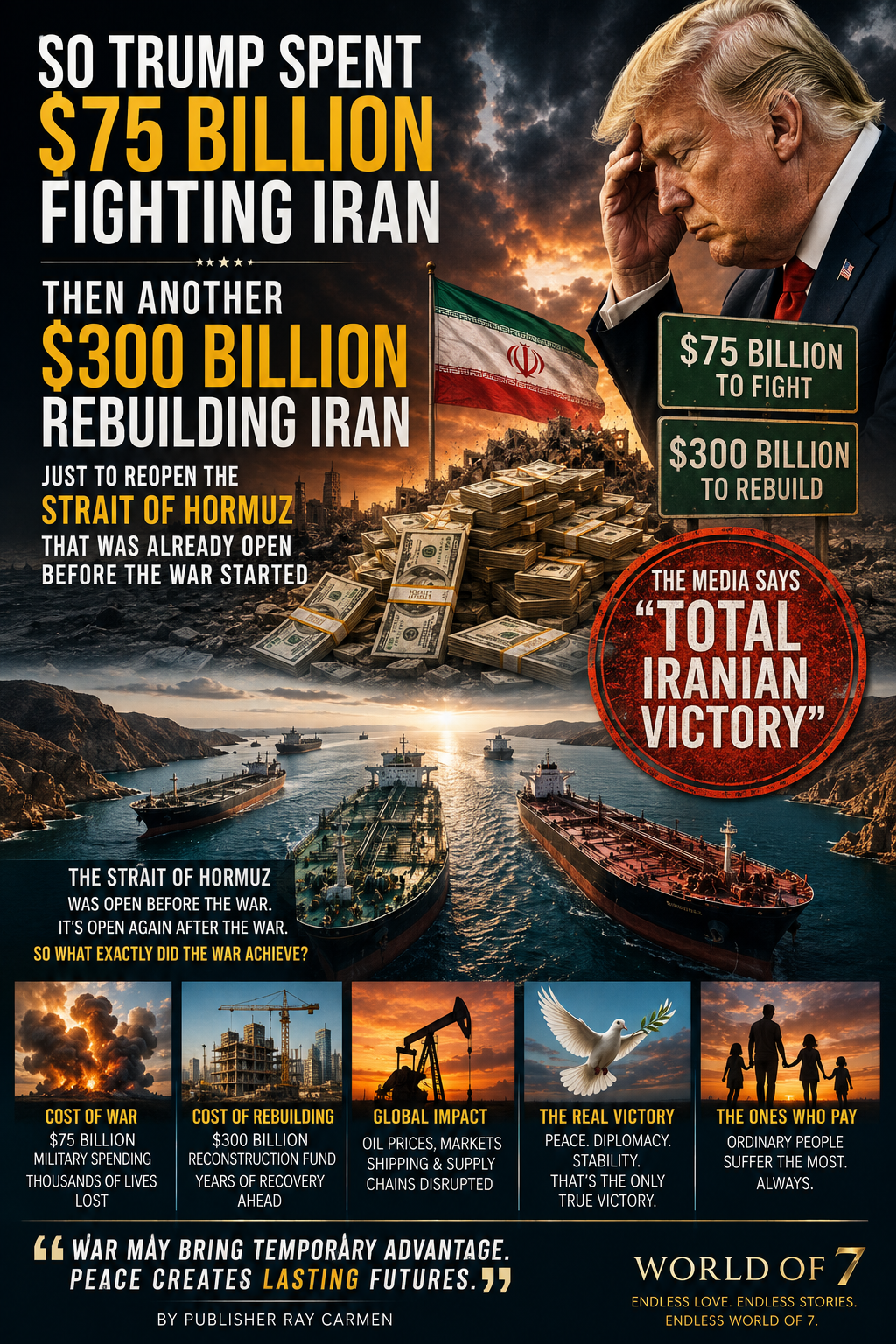
The Strait Of Hormuz Question
At the centre of the discussion is the strategically vital Strait of Hormuz.
Before the conflict, the waterway was functioning as one of the world’s most important energy corridors. Following the outbreak of war, shipping traffic was severely disrupted, creating major concerns for global energy markets.
Recent agreements between Washington and Tehran include provisions aimed at reopening the strait and restoring commercial shipping. However, maritime traffic remains far below normal levels and many vessels are still waiting for conditions to stabilise.
The $300 Billion Question
Another major talking point is a proposed $300 billion Reconstruction and Development Fund linked to the emerging U.S.-Iran framework agreement. According to reports, the fund would be financed by private investors from multiple regions and would support sectors such as energy, transport, manufacturing and logistics.
Supporters see this as a pathway to rebuilding and economic recovery.
Critics argue that the sheer scale of reconstruction highlights the enormous costs created by war in the first place.
Iran’s Claim Of Victory
Iranian officials have publicly described the outcome as a victory, arguing that the country preserved its strategic position and remained a key player in determining the future of the Strait of Hormuz.
Meanwhile, President Donald Trump has described the agreement as a major diplomatic achievement that will reopen the waterway, stabilise markets and prevent future conflict.
The Bigger Question
Perhaps the real question is not who won.
Perhaps the real question is whether anyone truly wins when wars cost lives, disrupt economies and leave nations facing years of rebuilding.
History often shows that military victories can be clear.
Political victories can be debated.
But the cost of war is usually paid by ordinary people long after the headlines disappear.
As the dust settles over the Middle East, the world will continue arguing about who won and who lost.
Yet millions of people may arrive at a simpler conclusion:
The greatest victory is the one achieved without war at all.