
THE WORLD OF CUISINE
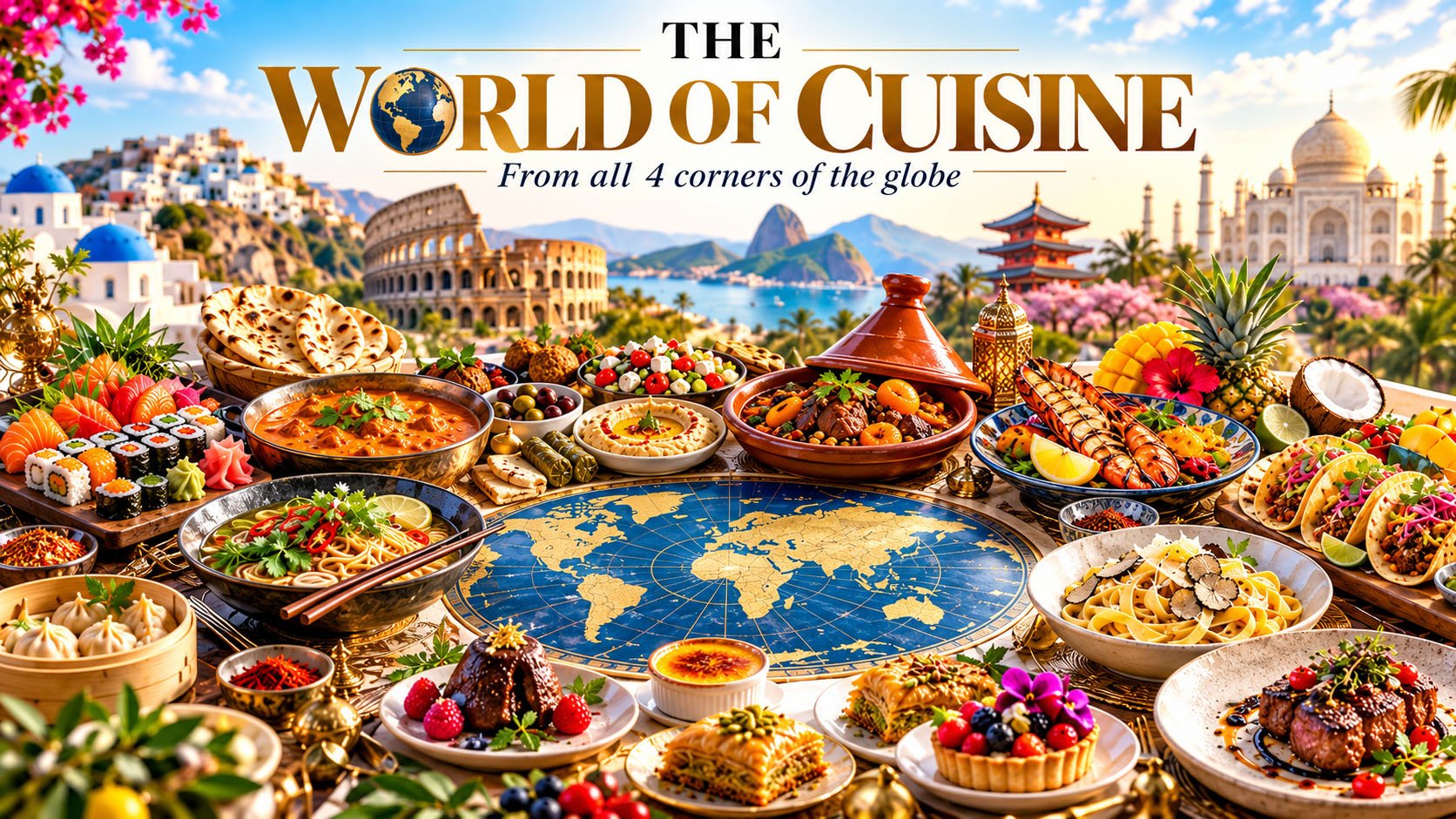
From All 4 Corners of the Globe
By Publisher Ray Carmen
ONE PLANET. SEVEN CONTINENTS. A THOUSAND FLAVOURS. ONE GLORIOUS FEAST!
A WORLD UNITED BY FOOD
There is one universal language that needs no translation, crosses every border and brings together people of every nationality, religion and culture.
It is the language of food.
From the aromatic spice markets of India to the elegant restaurants of Paris, from the sizzling barbecue grills of Argentina to the colourful street-food stalls of Thailand, the world offers an extraordinary banquet of flavours.
Every nation has its culinary treasures. Every continent has its signature dishes. Every family has recipes handed down through generations.
Food is more than nourishment. It is history, heritage, hospitality and identity.
WORLD OF 7 takes readers on a delicious journey across the seven continents, celebrating the extraordinary diversity of global cuisine.
1. EUROPE — THE CONTINENT OF CULINARY ELEGANCE
Europe has long been associated with some of the world’s most celebrated culinary traditions.
France has elevated cooking into an art form, with its delicate pastries, rich sauces, artisan cheeses and legendary fine-dining establishments.
Italy has given the world pizza, pasta, risotto, tiramisu and an enduring appreciation of simple ingredients prepared with passion.
Spain offers the irresistible pleasures of paella, tapas and seafood, while Greece celebrates fresh olive oil, grilled fish, feta cheese and traditional Mediterranean cooking.
Britain contributes its own culinary heritage, from Sunday roasts and fish and chips to afternoon tea and traditional puddings.
Across Europe, centuries of regional traditions have created an extraordinary gastronomic landscape.
The Mediterranean diet and its associated cultural practices have even been recognised by UNESCO as part of humanity’s intangible cultural heritage.
Signature European dishes: Italian pasta, Spanish paella, French coq au vin, Greek moussaka and British roast beef with Yorkshire pudding.
2. ASIA — THE KINGDOM OF SPICES AND EXOTIC FLAVOURS
Asia is arguably the world’s most diverse culinary continent.
Its extraordinary variety of ingredients, cooking techniques and regional traditions has influenced kitchens across the globe.
India offers fragrant biryanis, rich curries, tandoori specialities, delicate dosas and an astonishing range of vegetarian cuisine.
China’s culinary heritage stretches from Peking duck and Cantonese dim sum to Sichuan hotpot and hand-pulled noodles.
Japan is celebrated for sushi, sashimi, tempura and ramen, while Thailand combines sweet, sour, salty and spicy flavours in dishes such as tom yum soup and pad Thai.
Malaysia, Indonesia, Vietnam and Singapore contribute their own spectacular combinations of herbs, spices, seafood and tropical ingredients.
Across the Middle East, aromatic rice, grilled meats, mezze, dates and traditional breads form the foundations of celebrated food cultures.
Japan’s traditional dietary culture, known as washoku, has received UNESCO recognition for its cultural importance and connection to nature.
Signature Asian dishes: Indian biryani, Japanese sushi, Chinese dim sum, Thai green curry, Malaysian nasi lemak and Indonesian rendang.
3. AFRICA — A CONTINENT OF BOLD FLAVOURS AND ANCIENT TRADITIONS
Africa’s culinary heritage is as diverse as its landscapes, cultures and peoples.
From the Mediterranean shores of Morocco to the vibrant markets of Nigeria and the coastal kitchens of South Africa, African cooking offers extraordinary depth and variety.
Morocco is famous for aromatic tagines, couscous and fragrant combinations of spices, dried fruits and slow-cooked meats.
West Africa celebrates jollof rice, grilled fish, pepper soups and richly seasoned stews.
Ethiopia offers the distinctive experience of injera, a traditional sourdough flatbread served with an assortment of vegetables, lentils and meat dishes.
South Africa’s culinary traditions reflect Indigenous, European and Asian influences, producing specialities such as bobotie, boerewors and the celebrated braai.
Along the continent’s coastlines, fresh seafood and tropical ingredients play an important role in everyday cooking.
African cuisine is increasingly gaining international recognition, with chefs bringing traditional ingredients and techniques to contemporary restaurants.
Signature African dishes: Moroccan tagine, Nigerian jollof rice, Ethiopian injera, Senegalese thieboudienne and South African bobotie.
4. NORTH AMERICA — THE GREAT MELTING POT OF WORLD CUISINE
North America’s culinary identity has been shaped by Indigenous traditions, migration and centuries of cultural exchange.
The United States is famous for hamburgers, barbecue, fried chicken, steaks and regional specialities ranging from Louisiana gumbo to New England clam chowder.
New York offers one of the world’s great international dining scenes, where cuisines from virtually every continent can be enjoyed within a few city blocks.
Mexico has given the world tacos, enchiladas, tamales, mole and an extraordinary variety of dishes based on maize, beans, chillies and regional ingredients.
Canada contributes maple syrup, poutine, seafood and culinary traditions influenced by its Indigenous communities and immigrant populations.
The Caribbean, geographically part of North America, adds another magnificent dimension.
Jamaican jerk chicken, Trinidadian doubles, Barbadian flying fish, Cuban ropa vieja and the seafood specialities of the wider Caribbean reflect centuries of cultural interaction.
Traditional Mexican cuisine has received UNESCO recognition for its deep historical roots and community traditions.
Signature North American dishes: Mexican tacos, American barbecue, Canadian poutine, Jamaican jerk chicken and Trinidadian doubles.
5. SOUTH AMERICA — THE LAND OF FIRE, FLAVOUR AND PASSION
South American cuisine is a celebration of colour, freshness and bold cooking.
Argentina is internationally renowned for its beef and traditional asado, where meats are slowly grilled over an open fire.
Brazil offers feijoada, a hearty bean-and-meat stew, alongside churrasco, tropical fruits and regional seafood dishes.
Peru has emerged as a major destination for culinary travellers, celebrated for ceviche, lomo saltado and its remarkable variety of native potatoes and other ingredients.
Colombia contributes arepas, hearty soups and regional rice dishes, while Chile offers seafood, empanadas and traditional preparations inspired by its extensive coastline.
Across the Andes, Indigenous ingredients such as quinoa, maize and potatoes remain central to local cooking.
South America’s culinary traditions demonstrate how ancient food cultures can inspire some of the world’s most innovative contemporary restaurants.
Signature South American dishes: Argentine asado, Brazilian feijoada, Peruvian ceviche, Colombian arepas and Chilean empanadas.
6. OCEANIA — FRESH SEAFOOD, ISLAND FLAVOURS AND PACIFIC TRADITIONS
Oceania offers a remarkable culinary landscape stretching from Australia and New Zealand to the islands of the Pacific.
Australia’s food culture combines Indigenous ingredients with influences from Europe, Asia and the Middle East.
Its coastal cities are celebrated for fresh seafood, contemporary restaurants and innovative multicultural cooking.
New Zealand offers exceptional lamb, seafood and traditional Māori cuisine.
One of its most distinctive culinary traditions is hāngī, in which food is cooked using heated stones in an earth oven.
Across Fiji, Samoa, Tonga and other Pacific islands, coconut, taro, breadfruit, tropical fruits and freshly caught fish feature prominently.
These island cuisines reflect a close relationship between food, community and the natural environment.
Signature Oceanian dishes: New Zealand hāngī, Australian barramundi, Fijian kokoda, Samoan palusami and Pacific island seafood.
7. ANTARCTICA — DINING AT THE END OF THE EARTH
Antarctica presents an entirely different culinary experience.
The world’s southernmost continent has no Indigenous population and no traditional national cuisine.
Yet food plays an essential role in the lives of scientists, researchers and expedition teams working in one of Earth’s most challenging environments.
Research stations depend on carefully planned food supplies, including frozen ingredients, preserved produce and provisions transported from other continents.
Meals provide warmth, nutrition and an important sense of community during long periods of isolation.
Some stations celebrate international food traditions, reflecting the nationalities of the scientists and support personnel working there.
In Antarctica, a shared meal can become one of the most welcome moments of the day.
Signature Antarctic dining experience: International expedition meals prepared and shared at research stations.
THE WORLD’S GREAT STREET-FOOD CULTURE
Some of the most memorable meals on Earth are not served beneath crystal chandeliers.
They are discovered in bustling markets, roadside kitchens and small family-run establishments.
A steaming bowl of noodles in Bangkok.
Freshly prepared tacos in Mexico City.
A fragrant curry in Mumbai.
A plate of grilled seafood in Zanzibar.
A warm pastry in Paris.
Street food provides travellers with an immediate introduction to local culture.
It is often affordable, authentic and deeply connected to the daily lives of the communities that prepare it.
For many visitors, discovering a city’s street food is as memorable as visiting its most famous monuments.
THE RISE OF GLOBAL GASTRONOMIC TOURISM
Food has become one of the great attractions of international travel.
Travellers increasingly choose destinations not simply for their beaches, architecture or historical landmarks, but for their culinary experiences.
Cooking classes, vineyard visits, farmers’ markets, food festivals and restaurant experiences have become important parts of the tourism industry.
A journey through Italy might include learning to make pasta in Tuscany.
A visit to Japan could feature a traditional sushi experience.
In Morocco, travellers can explore spice markets and discover the secrets of tagine cooking.
Across the Caribbean, visitors can enjoy beachside seafood, rum-inspired culinary traditions and vibrant local food festivals.
Gastronomic tourism allows travellers to experience destinations through the flavours, ingredients and customs that make each place distinctive.
THE FUTURE OF WORLD CUISINE
The world’s culinary landscape continues to evolve.
International chefs are experimenting with new combinations of ingredients, introducing traditional dishes to global audiences and rediscovering forgotten regional recipes.
Plant-based cooking, sustainable seafood, locally sourced produce and efforts to reduce food waste are becoming increasingly important.
At the same time, there is renewed appreciation for traditional methods of cultivation, preparation and communal dining.
UNESCO has recognised numerous food-related cultural practices, highlighting the importance of preserving culinary knowledge for future generations.
The future of world cuisine will be shaped by innovation, but its foundations will remain rooted in tradition.
ONE PLANET. SEVEN CONTINENTS. ONE GLORIOUS FEAST.
The beauty of world cuisine lies in its extraordinary diversity.
A dish prepared in a small village kitchen can carry generations of history.
A family recipe can preserve the identity of an entire community.
A shared meal can bring together people who speak different languages and come from different cultures.
Food reminds us that, despite our differences, humanity shares a fundamental appreciation for flavour, hospitality and togetherness.
From the vineyards of Europe to the spice gardens of Asia, from the savannahs of Africa to the tropical islands of the Caribbean, our planet offers a never-ending feast of discovery.
At Caribbean World & WORLD OF 7, we celebrate that remarkable culinary inheritance.
Because the world is not simply a place to explore. It is a world to taste.
And every continent has a story waiting to be served.