
THE MICHELIN GUIDE — THE STARS EVERY CHEF DREAMS OF WINNING
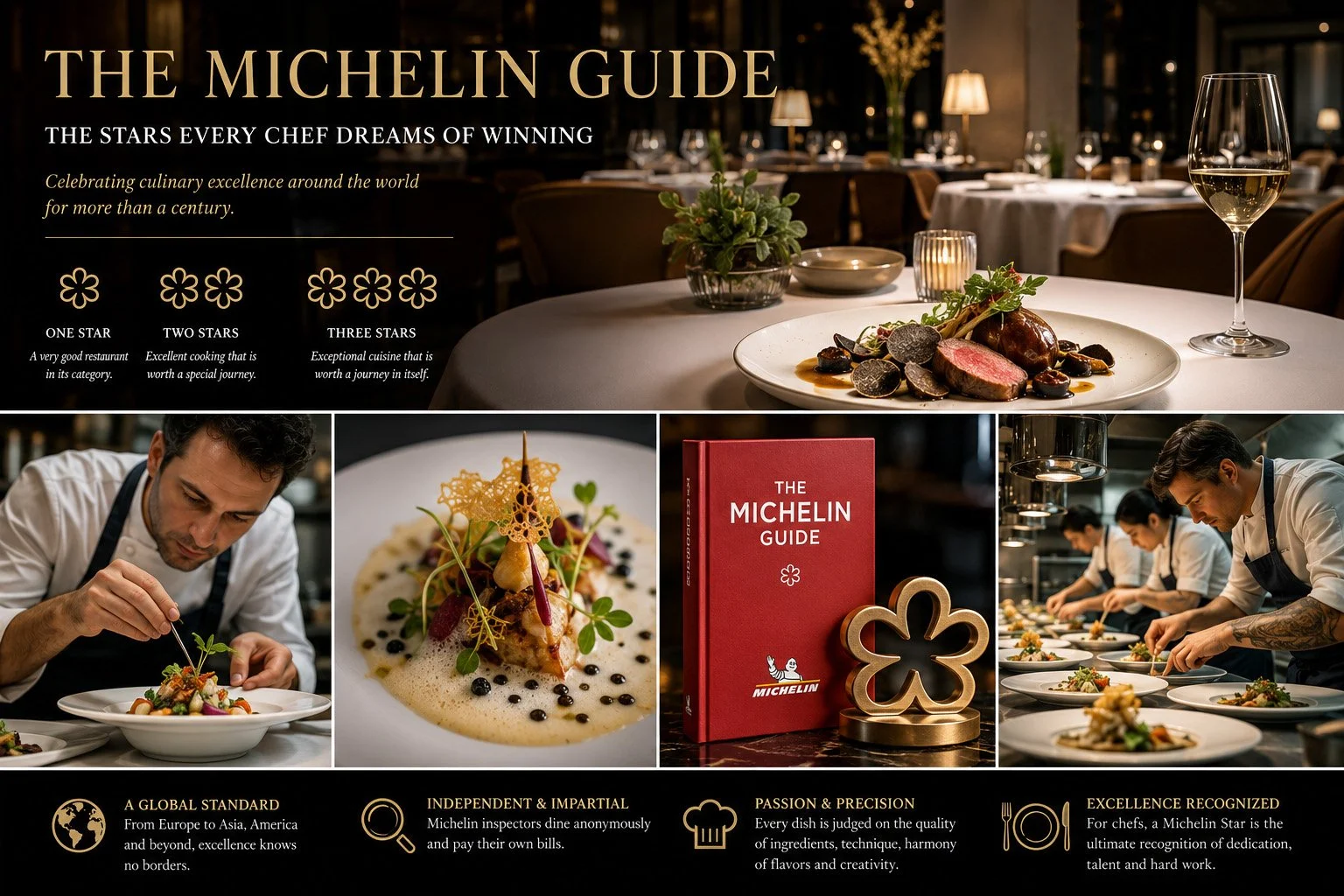
From a simple motoring guide to the world's most influential restaurant rating, discover how the Michelin Guide became the ultimate symbol of culinary excellence.
By Publisher Ray Carmen
For chefs across the world, few honours carry as much prestige as a Michelin Star.
Receiving even a single star can transform a restaurant overnight, attracting diners from across the globe and placing it among the world's finest dining destinations.
Today, the Michelin Guide is regarded as the gold standard of restaurant excellence, but its remarkable journey began with a surprisingly simple idea.
A Guide Born on the Road
The Michelin Guide was first published in France in 1900 by brothers André and Édouard Michelin, founders of the Michelin tyre company.
At the time, there were relatively few motor cars on French roads. The guide was designed to encourage people to travel more by providing useful information about hotels, mechanics, fuel stations and places to eat.
The more people travelled, the more tyres they would need.
What began as a clever marketing initiative gradually evolved into one of the world's most respected restaurant guides.
The Birth of the Michelin Star
In 1926, the guide began recognising exceptional restaurants with a single star.
A few years later, the now-famous three-star system was introduced:
One Star – A very good restaurant in its category.
Two Stars – Excellent cooking that is worth making a special journey for.
Three Stars – Exceptional cuisine that is worth travelling specifically to experience.
Today, these distinctions remain among the highest achievements in global gastronomy.
How Restaurants Are Judged
Michelin inspectors visit restaurants anonymously, paying for their meals like any other customer.
Their assessments focus primarily on the quality of the food rather than luxury surroundings.
Among the factors considered are:
The quality of ingredients.
Mastery of cooking techniques.
Harmony of flavours.
The personality of the chef reflected in the cuisine.
Consistency across multiple visits.
This commitment to independence has helped the Michelin Guide earn worldwide respect.
More Than Luxury
While many Michelin-starred restaurants are elegant fine-dining establishments, excellence is not reserved exclusively for luxury venues.
Over the years, inspectors have recognised modest neighbourhood restaurants, family-owned establishments and even small street-food venues for outstanding cooking.
This demonstrates that exceptional food is defined by skill, passion and consistency—not by expensive décor.
A Global Standard
Originally focused on Europe, the Michelin Guide now covers major culinary destinations across the world.
Restaurants in Japan, Singapore, South Korea, the United States and many other countries have earned Michelin recognition, reflecting the increasingly global nature of fine dining.
Japan is now home to one of the highest concentrations of Michelin-starred restaurants anywhere in the world, demonstrating the country's extraordinary commitment to culinary excellence.
The Michelin Effect
Receiving a Michelin Star can dramatically change a restaurant's future.
Reservations often increase significantly, international media take notice and travellers frequently plan entire holidays around visiting acclaimed restaurants.
For chefs, the recognition represents years—sometimes decades—of dedication, sacrifice and continuous improvement.
Yet maintaining those stars requires unwavering consistency, with every service expected to meet the highest standards.
Inspiring Future Generations
The Michelin Guide has encouraged chefs around the world to push the boundaries of creativity while respecting the traditions that define great cuisine.
It has also inspired countless young cooks to pursue careers in hospitality, dreaming of one day earning the stars that symbolise the very best in their profession.
As dining continues to evolve, sustainability, local sourcing and responsible cooking are becoming increasingly important parts of the global culinary conversation.
The Ultimate Culinary Honour
For more than a century, the Michelin Guide has celebrated restaurants that combine craftsmanship, innovation and an uncompromising commitment to quality.
Whether serving an elaborate tasting menu or a beautifully prepared local speciality, Michelin-recognised restaurants demonstrate that great food has the power to inspire, surprise and create lifelong memories.
As WORLD OF 7 celebrates the finest culinary experiences across the seven continents, the Michelin Guide stands as a reminder that true excellence is never achieved by chance—it is earned through passion, dedication and the relentless pursuit of perfection.
A MICHELIN STAR IS MORE THAN AN AWARD—IT IS A SYMBOL OF A CHEF'S LIFELONG COMMITMENT TO EXCELLENCE.