
SAMOSA BEATS BURGERS!
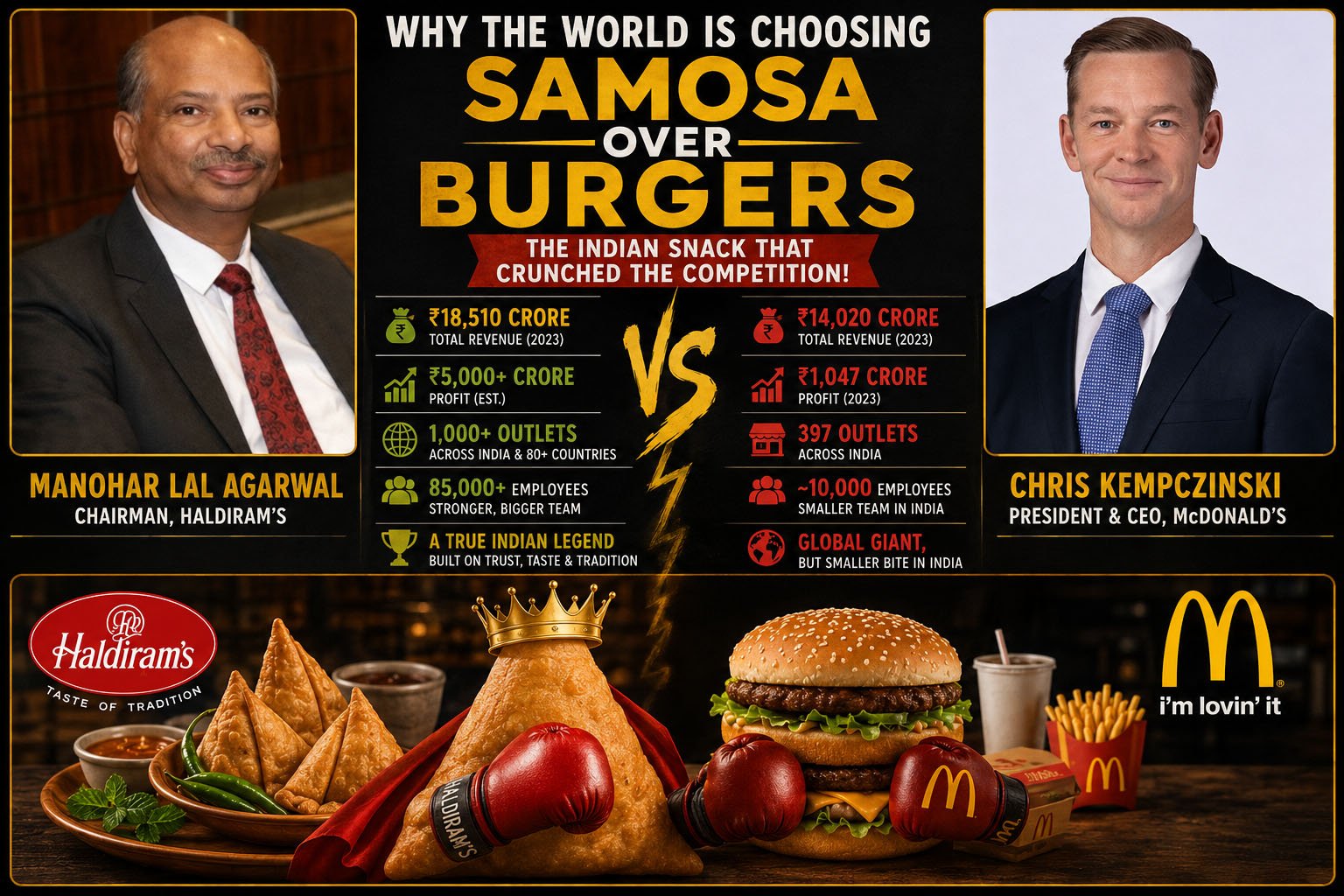
THE HUMBLE INDIAN SNACK THAT APPARENTLY SENT THE GOLDEN ARCHES LOOKING FOR CHUTNEY
By Publisher Ray Carmen
For years, the burger strutted around like the undisputed emperor of fast food—two buns, a shiny wrapper and enough confidence to open restaurants across the planet.
Then a small, triangular gentleman arrived carrying potatoes, peas and a dangerous quantity of spice.
His name was Samosa.
A viral comparison circulating on Instagram claims that Haldiram’s has more than 400 outlets, approximately ₹8,000 crore in revenue and around ₹800 crore in profit, compared with roughly 550 McDonald’s restaurants in India, ₹4,500 crore in revenue and ₹180 crore in profit. Those figures have been widely reposted, but they should be treated as broad social-media estimates rather than a clean audited comparison.
Why? Because Haldiram’s is not merely a restaurant chain. It is a huge packaged-food, sweets, snacks, manufacturing and export business selling hundreds of products in markets around the world. McDonald’s India, meanwhile, operates through different regional corporate structures and franchise arrangements. Comparing their headline totals is rather like comparing an entire Indian wedding feast with one burger counter.
Even so, the larger message is deliciously clear:
India’s traditional flavours are not being flattened by global fast food. They are fighting back—with chutney.
Haldiram’s began as a modest family sweet-and-snack shop in Bikaner in 1937. It grew into a food empire selling more than 400 varieties across around 100 countries, with particularly strong positions in traditional Indian savouries and salty snacks.
The company’s scale has attracted some very serious appetites. In 2025, Singapore’s Temasek agreed to acquire nearly 10% of Haldiram’s in a deal valuing the business at approximately US$10 billion.
McDonald’s is still a vastly larger global corporation, so Ronald need not pawn his red shoes. Its worldwide revenue was nearly US$27 billion in 2025. But inside India, the success of Haldiram’s demonstrates that familiarity, vegetarian choice, cultural loyalty and the irresistible smell of frying samosas can give even the Golden Arches a serious run for their money.
McDonald’s has the Big Mac.
Haldiram’s has the Big Masala.
McDonald’s asks, “Would you like fries with that?”
The samosa replies, “No, thank you—bring me mint chutney, tamarind chutney and stand back.”
THE FINAL VERDICT
The viral statistics are not a perfect apples-to-apples—or burgers-to-bhujia—comparison.
But the commercial triumph is real.
A snack once sold from a small shop has become part of a multibillion-dollar Indian food empire, proving that globalisation does not always mean the burger conquers the world.
Sometimes, the samosa eats the burger for breakfast.
SAMOSA: 1. BURGER: PLEASE TAKE A TOKEN AND WAIT.
WORLD OF 7 — THE WORLD, SERVED WITH EXTRA CHUTNEY.