
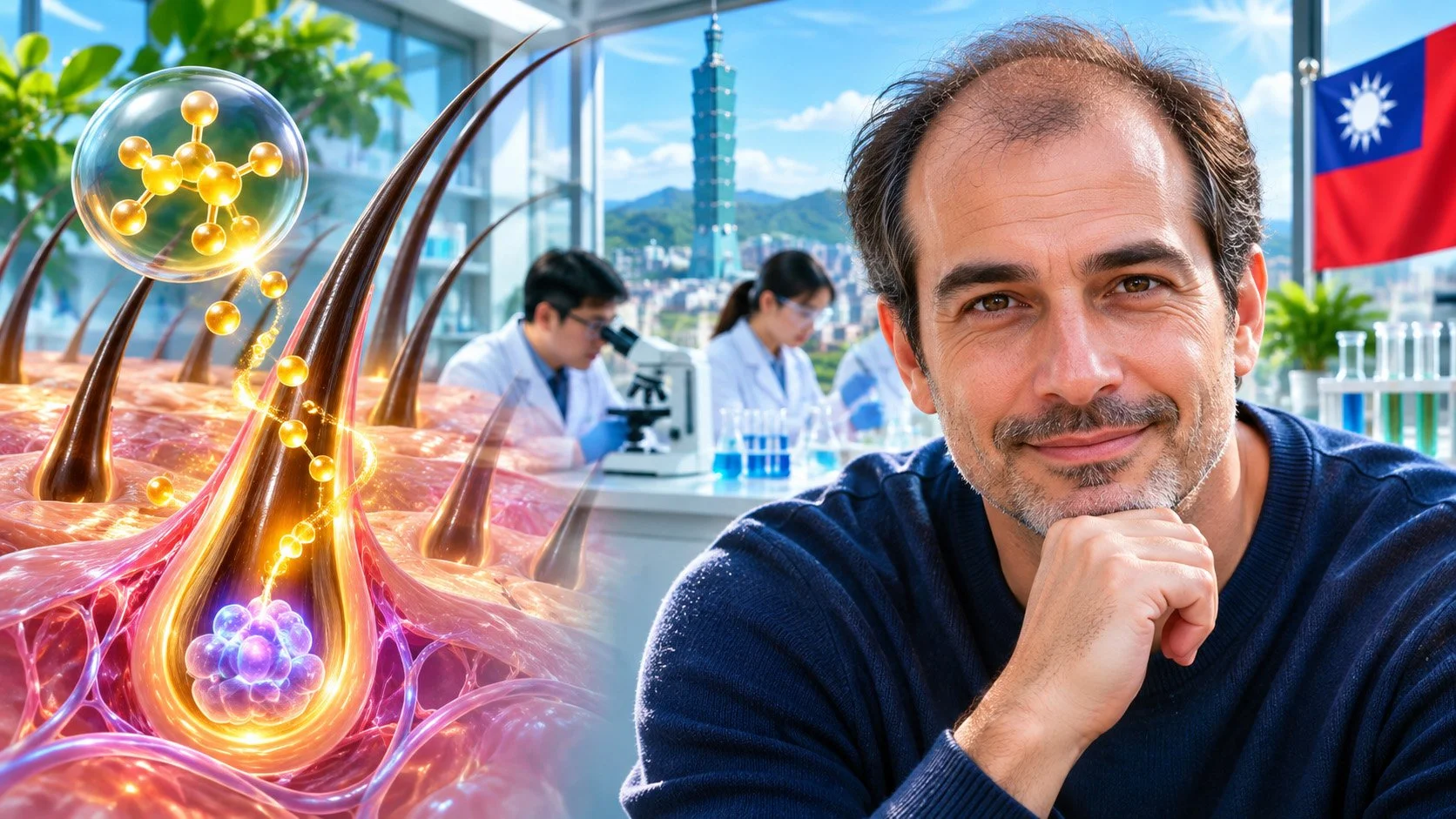
TAIWAN’S 20-DAY HAIR REGROWTH DISCOVERY — COULD IT CHANGE MILLIONS OF LIVES?
By Publisher Ray Carmen
A remarkable experiment at National Taiwan University awakened dormant hair follicles in mice. The discovery could reshape future research, but it is not yet a proven cure for human baldness.
For millions of men and women who have watched their hairline retreat, news of a serum that can bring back hair in just 20 days sounds almost too good to be true. Scientists in Taiwan have indeed achieved something remarkable. But beneath the viral headlines lies a more intriguing story: not a miracle cure already available to the public, but the discovery of a biological switch that could one day open new routes to treating hair loss.
HOW THE DISCOVERY BEGAN
Researchers at National Taiwan University, in a team led by Professor Sung-Jan Lin, investigated an observation familiar to some clinicians: skin that has been injured or irritated can subsequently grow more hair. They wanted to understand the molecular conversation between the skin, its immune cells and its hair follicles.
A MESSAGE FROM FAT CELLS
Their investigation found that after skin injury, immune cells called macrophages can stimulate fat cells beneath the skin to release free fatty acids. Those fatty acids are taken up by hair-follicle stem cells, changing the cells’ energy metabolism and helping them leave their resting state. In simpler terms, the surrounding tissue appears able to send a “wake-up” signal to the machinery that makes hair.
THE 20-DAY RESULT
In controlled experiments on mice, the team reported activation of hair-follicle stem cells by around day seven, visible new hair around day ten and substantial or complete regrowth in the treated areas by about day twenty. Importantly, the researchers also showed that applying certain monounsaturated fatty acids directly to uninjured mouse skin could trigger hair growth without first causing injury. Two of the fatty acids discussed in reporting about the work are oleic acid and palmitoleic acid.
NOT A CURE FOR PEOPLE — YET
This is the crucial distinction. The striking 20-day timeline describes mouse experiments. The peer-reviewed work did not establish that a serum restores a balding human scalp in three weeks, and the team’s findings have not been confirmed in a successful human clinical trial. A laboratory result cannot simply be transferred to people: human hair cycles are different, and different forms of hair loss have different causes.
WHY SCIENTISTS ARE INTERESTED
The study, published online in Cell Metabolism on 22 October 2025, offers more than an attractive headline. It identifies a pathway linking immune activity, skin fat cells and follicle stem cells. That may provide scientists with new molecular targets for future therapies. National Taiwan University has also discussed the possibility of developing a topical formulation. A patent application associated with the research was disclosed in the paper.
WHAT HAPPENS NEXT?
Researchers would need to test the formulation rigorously in people, establish safe doses, assess whether it works for common conditions such as androgenetic hair loss, and determine whether any benefit lasts. A promising result in mice is an important beginning, not the end of the journey. For now, anyone experiencing hair loss should seek established medical advice rather than trying homemade fatty-acid mixtures or irritating their scalp.
A BREAKTHROUGH WORTH WATCHING
If human research ultimately confirms the mechanism and shows meaningful results, Taiwan’s contribution could help change the future of hair-loss treatment. Until then, the accurate headline is both hopeful and honest: scientists have uncovered an exciting way to stimulate hair regrowth in mice in 20 days. The world is watching to see whether that science can make the leap to people.
THE KEY FACT
Hair regrowth in about 20 days was observed in mice. It is not a clinically demonstrated cure for human baldness.