
ISLAM’S RAPID GROWTH IN JAPAN — MUSLIM POPULATION ESTIMATED AT AROUND 420,000
By Publisher Ray Carmen
A once-small community is becoming an increasingly visible part of modern Japanese society
Japan has long been associated with Shinto and Buddhism, but the country’s changing population is also bringing greater religious and cultural diversity.
One of the most striking developments is the rapid growth of Japan’s Muslim community.
Research by Hirofumi Tanada, Professor Emeritus at Waseda University, estimates that approximately 420,000 Muslims were living in Japan at the end of 2024 and beginning of 2025. That represents around 0.3 per cent of Japan’s total population — still a small proportion nationally, but a remarkable increase from previous decades.
Tanada’s latest estimate divides the population into approximately 363,000 foreign Muslims and 55,000 Japanese Muslims. His research shows just how dramatically the community has expanded: the estimated foreign Muslim population alone rose from about 184,000 at the end of 2020 to more than 363,000 by the end of 2024.
A CHANGING JAPAN
Much of this growth is connected to Japan’s changing labour force and its increasing internationalisation.
Muslims have arrived from countries across Asia, the Middle East and Africa to work, study, conduct research and establish businesses. Indonesia has become particularly significant, while communities with roots in Pakistan, Bangladesh, Türkiye and other Muslim-majority countries have also become established.
Tanada identifies employment, education, longer-term residence, marriage and Japan’s expanding intake of overseas workers among the important factors behind the increase. Japanese Muslims — including converts, naturalised citizens and children growing up in Muslim families — form another part of this evolving community.
This is therefore not simply a story about religion. It is also a story about demographic change in one of the world’s most fascinating societies.
MOSQUES ACROSS JAPAN
The physical landscape is changing too.
For decades, mosques were extremely rare in Japan. Tanada notes that only a handful existed during much of the twentieth century. By 2024 there were around 150 mosques, while reporting by Kyodo in June 2026 put the nationwide number at more than 160.
Tokyo today has several Muslim places of worship, while mosques and prayer facilities can also be found in cities and prefectures throughout the country.
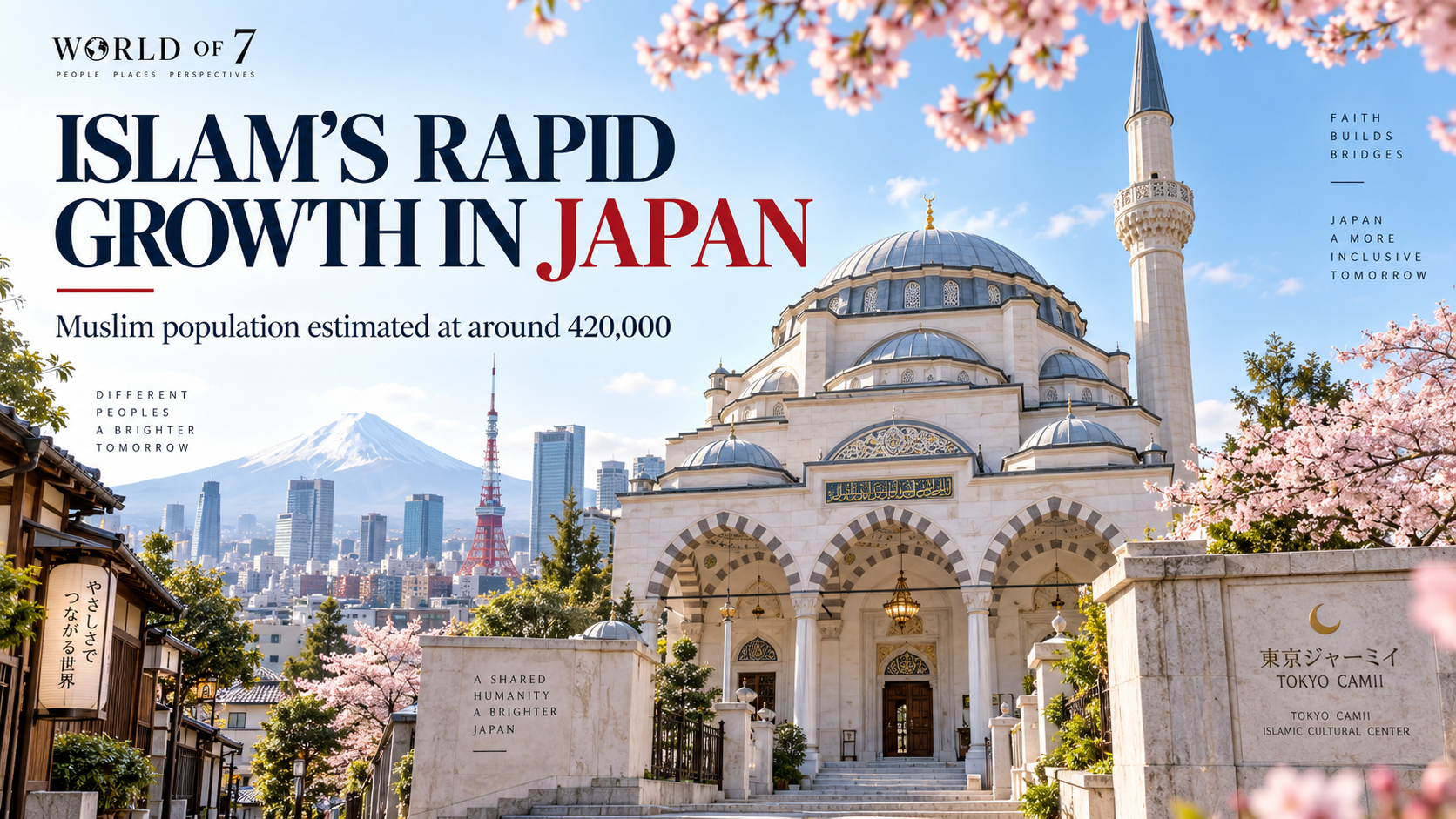
Perhaps the most visually striking symbol of Islam in Japan is Tokyo Camii, whose Ottoman-inspired architecture provides an extraordinary contrast with the modern Tokyo cityscape.
The expanding Muslim presence has also made Islamic culture increasingly visible in everyday Japanese life, particularly in major cities and areas with large international populations.
IS ISLAM JAPAN’S FASTEST-GROWING RELIGION?
Social-media posts frequently describe Islam as “Japan’s fastest-growing religion.”
There is no doubt that Japan’s Muslim population is growing rapidly. One Japanese Islamic organisation itself uses the description “fastest growing religion in Japan.” However, Japan does not have sufficiently comprehensive comparative religious-affiliation statistics to establish that ranking conclusively across every religion.
For World of 7, therefore, the more accurate story is even more interesting: Islam has become one of the most rapidly expanding and increasingly visible religious communities in contemporary Japan.
Globally, the trend is unmistakable. Pew Research Center found that Muslims were the world’s fastest-growing major religious group between 2010 and 2020, increasing by around 347 million people during that decade.
TRADITION MEETS A CHANGING WORLD
Japan remains overwhelmingly shaped by its own ancient traditions, customs and culture. Yet alongside its temples, shrines, skyscrapers and high-speed trains, another Japan is quietly emerging — one that is increasingly international and multicultural.
The estimated 420,000 Muslims now living in Japan represent only a fraction of the country’s population.
But the direction of travel is unmistakable.
From Tokyo to Osaka and from university campuses to international workplaces, Japan’s Muslim community has become part of the changing face of one of Asia’s great nations.
In a country famous for preserving tradition while embracing the future, Japan is once again demonstrating that the two can exist side by side.