
A Royal Day in the Twin Islands
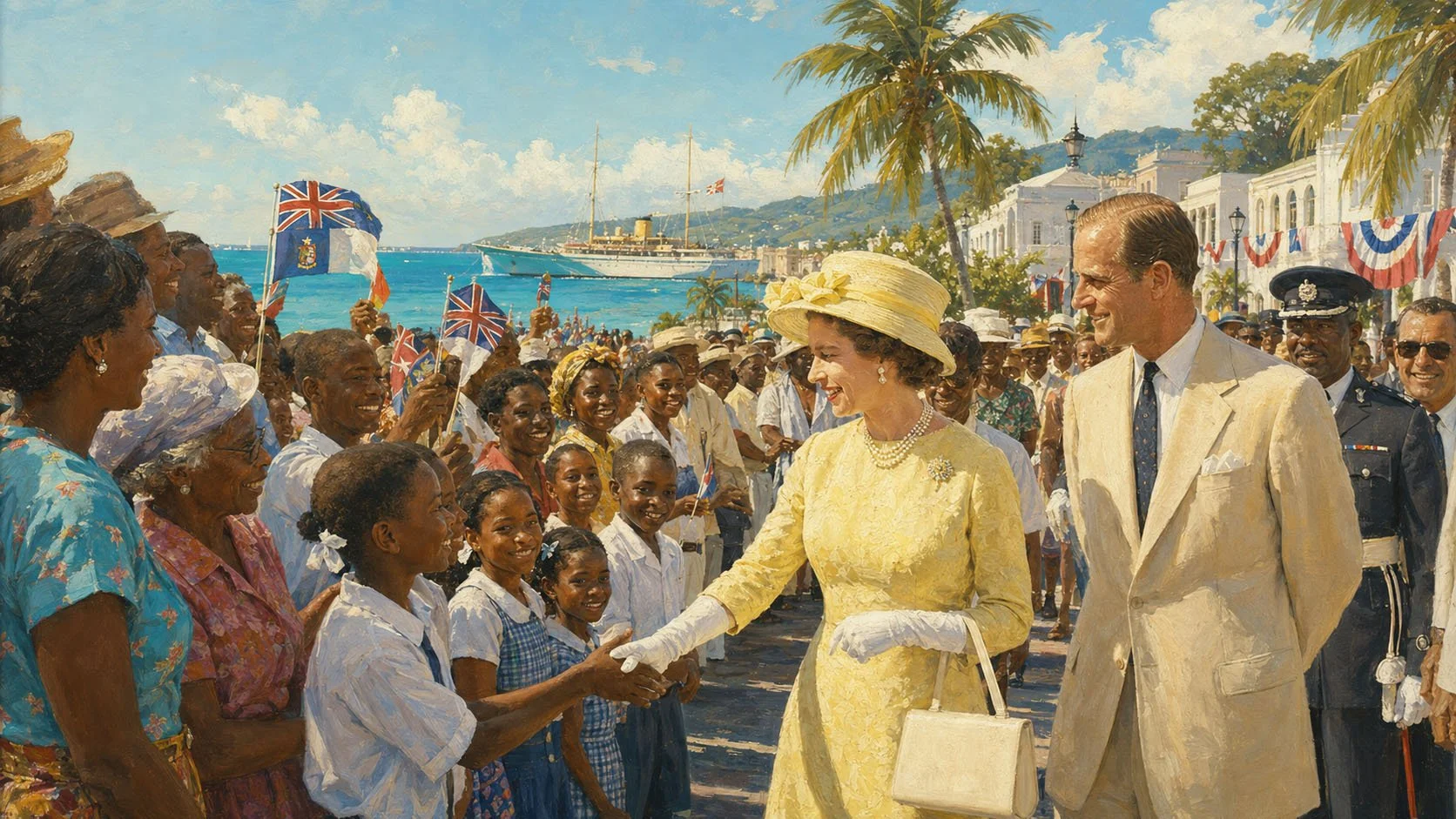
Queen Elizabeth II and Prince Philip in St Kitts and Nevis, 1966
22 February 1966 | Memory, Pageantry and a Caribbean World in Transition
By Publisher Ray Carmen
A Caribbean World in Transition
On 22 February 1966, Queen Elizabeth II and Prince Philip arrived in St Kitts and Nevis during an ambitious West Indies tour. The photographs preserve the ceremony; the islands remember something larger - a brilliant public occasion poised between colonial rule and a rapidly approaching political future.
Basseterre would have understood the language of a royal arrival long before the ship came into view: bunting lifted above the streets, uniforms made ready, schoolchildren rehearsing, official cars polished until they carried the sun. Then came the human sound - the gathering crowds, the bands, the calls from pavement and waterfront as the Queen and the Duke of Edinburgh entered the life of the islands for a brief, carefully choreographed day.
The visit formed part of a month-long royal journey through the West Indies. The British Film Institute's surviving documentary record names a remarkable itinerary: British Guiana, Trinidad and Tobago, Grenada, St Vincent, Barbados, St Lucia, Dominica, Montserrat, Antigua, St Kitts-Nevis-Anguilla, Tortola, the Bahamas and Jamaica. Buckingham Palace had announced the tour in July 1965; by February 1966, it had become a moving theatre of monarchy across a region redefining itself.
In St Kitts and Nevis, that theatre met local pride. This was not yet today's independent Federation. The three-island territory of St Christopher-Nevis-Anguilla remained under British administration. Associated statehood would come in 1967; the modern Federation of St Kitts and Nevis would achieve independence in 1983. The royal couple therefore arrived at a hinge in history.
"The day belonged to the Crown - but its colour, energy and meaning belonged to the Caribbean people who filled it."
Ceremony in Basseterre
Accounts of 22 February place the Queen at Government House in St Kitts for an investiture attended by about 50 guests. The ritual was formal and intimate: honours bestowed, names read, service made visible through the symbols of empire. Afterwards, the scale widened. A reception reportedly brought together some 700 people - public officials, community representatives and invited guests sharing one of the territory's most anticipated occasions.
A royal tour depended upon protocol, but it also depended upon proximity. The motorcade and public appearances allowed islanders to see the monarch not as a portrait on a wall or a profile on a coin, but as a person moving through familiar streets. For children especially, the day became the kind of memory told decades later: where they stood, what they wore, how long they waited and whether the Queen looked in their direction.
Later, fireworks were viewed from the Basseterre waterfront. Against the Caribbean night, the display transformed official ceremony into communal spectacle. It is easy to imagine the harbour carrying each burst of colour, the crowd looking upward while the outline of the town held steady behind them.
The Day at a Glance
Date: Tuesday, 22 February 1966
Territory: St Christopher-Nevis-Anguilla, then under British administration
St Kitts: Government House investiture; reception of about 700; waterfront fireworks
Nevis: Public welcome and a presentation by Chief Minister C. A. Paul Southwell
Wider tour: A month-long official journey through the West Indies
The surviving summaries are precise about the formal programme but less complete about the thousands of individual experiences around it. That absence is itself important. Official archives preserve office-holders and ceremonies; family albums and oral histories preserve the crowd. Together they make the day whole.
Nevis Takes Its Place
The royal programme also carried the Queen and Prince Philip across to Nevis. There, the island's scale changed the character of the visit. Nevis could never be treated merely as an appendix to St Kitts: its communities possessed their own loyalties, grievances, traditions and sense of place. A royal arrival offered a rare moment when the smaller island stood at the centre of the official picture.
At Government House in Nevis, Chief Minister Caleb Azariah Paul Southwell presented the Queen with a large relief map of the island. The gift was both geographic and symbolic. It asked the visitor to look closely - to see the mountain rising at the island's centre, the settlements around its coast and Nevis as a place with its own shape, rather than a name joined to another by punctuation.
Southwell was one of the territory's most important political figures, serving as chief minister during a period of constitutional change. The map presentation placed local leadership beside royal authority, each occupying a different place in a political order that was already moving toward greater self-government.
For the islanders who assembled, pageantry did not cancel everyday reality. Sugar's long shadow remained across the landscape and economy. The architecture of plantation society, built through enslaved African labour, was part of the ground beneath the welcome. To tell the visit well is therefore to hold beauty and history together: tropical colour and formal dress, popular excitement and the unequal colonial system from which the ceremony came.
"The Caribbean was not a painted background for monarchy. It was the living subject of the day."
That distinction matters. The best surviving images invite us to study not only the royal couple but the faces around them: officials standing to attention, women in carefully chosen dresses, children leaning for a better view, elders measuring the occasion through memories of earlier reigns. The crowd turns an imperial tour into local history.
What the Visit Means Now
In 1966, the map of the Caribbean was changing with extraordinary speed. Trinidad and Tobago had become independent in 1962; Barbados would follow later that same year. Across the region, questions once framed as distant constitutional matters were becoming immediate: who would govern, whose history would be taught, what relationship should survive with Britain and what nationhood should look like in islands connected by sea but distinct in identity.
St Christopher-Nevis-Anguilla moved into associated statehood in February 1967, gaining control over internal affairs while Britain retained responsibility for defence and external relations. The arrangement soon fractured amid Anguilla's determination to separate. By the time St Kitts and Nevis became independent on 19 September 1983, the political landscape of the royal visit had been transformed.
Queen Elizabeth II and Prince Philip returned in October 1985, this time visiting an independent Commonwealth realm. That second visit belonged to a different constitutional world. The Queen was no longer arriving as sovereign of a colony but as Queen of St Christopher and Nevis under the country's own constitution.
The contrast gives 1966 its historical power. It was a farewell without announcing itself as one - among the last great Caribbean tours conducted across a chain of colonies and newly independent states under one royal itinerary. Its polished ceremonies projected continuity, while the region itself was creating change.
Today, photographs and film from that day circulate again, especially through community pages where descendants recognise a relative in the crowd or recover a story heard in childhood. Social media can strip images of dates and context, but it can also return public history to the families who lived it. A single Facebook post may reopen an archive of memory.
The responsibility is to caption that memory correctly. Queen Elizabeth II - not "Elizabeth 11" - visited with Prince Philip in 1966; the islands were then part of St Christopher-Nevis-Anguilla; independence lay seventeen years ahead. Accuracy does not diminish nostalgia. It gives nostalgia a true address.
A Day the Islands Made Their Own
The 1966 visit endures because it brought the grand scale of monarchy into the intimate geography of two small Caribbean islands. For one day, Government House, Basseterre's waterfront and the Nevis landscape became stages in a world tour. Yet the most lasting images are not of power descending from abroad. They are of local people turning ceremony into memory.
Queen Elizabeth II and Prince Philip supplied the occasion. St Kitts and Nevis supplied its warmth, its crowds, its music, its night sky and the generations who would continue to tell the story.
Seen from the present, the visit belongs neither to simple celebration nor easy rejection. It should be read with clear eyes: as royal pageantry, as colonial history, as a record of Caribbean community and as a moment just before constitutional change gathered speed.
That is why the image still travels. Behind the hats, uniforms and waving hands is a country coming gradually into view - already proud of its islands, already conscious of their differences, and moving toward the day when it would speak to the world in its own name.