
EARTH’S SECOND MOON?
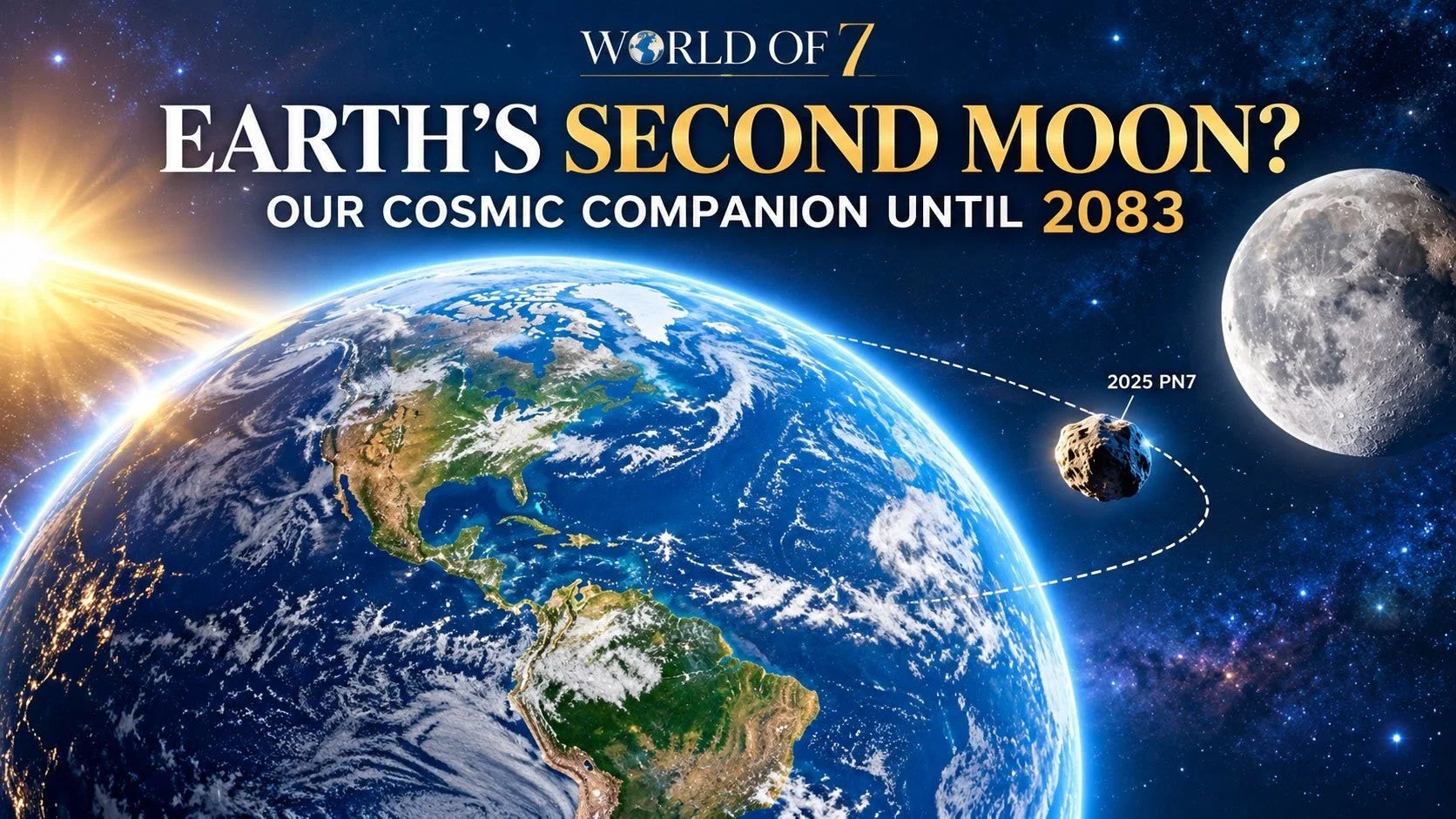
OUR MYSTERIOUS COSMIC COMPANION UNTIL 2083
By Publisher Ray Carmen
Astronomers discover a tiny asteroid travelling alongside Earth — but is it really another Moon?
A MYSTERIOUS COMPANION IN THE HEAVENS
For thousands of years, humanity has gazed towards the night sky and marvelled at the magnificent Moon illuminating our planet.
From the ancient civilisations of Asia and Europe to the tropical islands of the Caribbean, the Moon has inspired poets, scientists, explorers and dreamers.
Now astronomers have identified another celestial object travelling alongside Earth on its extraordinary journey around the Sun.
The discovery has generated international headlines suggesting that our planet has acquired a second Moon.
Even more astonishingly, scientists predict that this mysterious companion could remain in its present orbital relationship with Earth until approximately 2083.
But is our planet really about to enjoy two moons?
The answer is both fascinating and scientifically surprising.
Earth has not acquired a second true Moon. Instead, astronomers have identified a small asteroid known as 2025 PN7, which belongs to a remarkable category of objects called quasi-moons.
And its story reveals just how much remains to be discovered in our own cosmic neighbourhood.
THE DISCOVERY THAT CAPTURED THE WORLD
The asteroid, officially designated 2025 PN7, was detected in August 2025 by astronomers using the Pan-STARRS telescope system in Hawaii.
The discovery attracted considerable attention because of the asteroid’s unusual relationship with Earth.
Unlike most asteroids, which travel around the Sun on distinctly different paths, 2025 PN7 follows an orbit remarkably similar to that of our planet.
It takes approximately one year to complete its journey around the Sun.
Because its orbital period closely matches Earth’s, the asteroid can appear to accompany our planet through space.
Astronomers call this arrangement a quasi-satellite orbit.
It is an extraordinary example of the delicate gravitational relationships that govern our solar system.
The discovery was documented in scientific research published in September 2025.
WHAT EXACTLY IS A QUASI-MOON?
To understand the discovery, we must first distinguish between a genuine moon and a quasi-moon.
Our familiar Moon is a natural satellite gravitationally bound to Earth.
It completes an orbit around our planet approximately every 27.3 days relative to the distant stars.
Its gravitational influence contributes significantly to the tides of Earth’s oceans.
A quasi-moon behaves differently.
Although it appears to travel alongside Earth, it actually orbits the Sun.
Its orbital path is synchronised with Earth’s in a relationship astronomers describe as a 1:1 orbital resonance.
Viewed from Earth over time, the asteroid can appear to trace an unusual looping path around our planet.
However, it is not gravitationally captured as a permanent satellite.
This distinction is essential.
2025 PN7 is a cosmic travelling companion, not a replacement or rival for our magnificent Moon.
WHY THE YEAR 2083?
Perhaps the most intriguing aspect of the discovery is the prediction that 2025 PN7 will remain in its present quasi-satellite arrangement until approximately 2083.
Astronomers studying its trajectory believe that the asteroid entered this orbital configuration around the mid-1960s.
That means it may have been accompanying Earth for roughly six decades before scientists identified it.
Throughout the Apollo space programme, the construction of modern satellites and the development of the International Space Station, this tiny celestial traveller was quietly following its own path around the Sun.
Current orbital calculations suggest that gravitational interactions will eventually alter its trajectory.
Around 2083, the asteroid is expected to leave its present quasi-satellite configuration.
It will not suddenly disappear from the solar system.
Instead, it will continue orbiting the Sun in a different relationship with Earth.
These predictions are based on orbital models and may be refined as additional observations become available.
HOW BIG IS EARTH’S COSMIC COMPANION?
Despite the dramatic headlines, 2025 PN7 is remarkably small.
Astronomers estimate that it measures approximately 20 metres across, although its precise dimensions remain uncertain.
That makes it comparable in size to a modest building.
Our Moon, by comparison, measures approximately 3,475 kilometres in diameter.
The difference is enormous.
2025 PN7 is also extremely faint.
It cannot be seen with the naked eye.
Even powerful amateur telescopes would struggle to detect it under ordinary observing conditions.
Astronomers require sensitive instruments and careful calculations to identify and track such small objects.
Consequently, nobody looking towards the Caribbean night sky should expect to see two enormous moons illuminating the ocean.
The spectacular image accompanying this article is an artistic representation, not an actual photograph of two moons visible from Earth.
IS THERE ANY DANGER TO OUR PLANET?
The discovery naturally raises another question.
Could this asteroid collide with Earth?
Current research does not identify 2025 PN7 as a threat to our planet.
Its quasi-satellite relationship is a consequence of its orbital motion around the Sun.
Although it occasionally approaches Earth on astronomical scales, its known trajectory does not indicate an impending collision.
Its small size also means it has no meaningful influence on Earth’s ocean tides.
The tides will continue to be governed primarily by the gravitational influence of our familiar Moon and the Sun.
Scientists nevertheless study near-Earth asteroids carefully.
Tracking their movements helps astronomers understand the population of small objects travelling through the inner solar system.
It also contributes to planetary-defence research.
EARTH HAS OTHER COSMIC COMPANIONS
Perhaps the greatest surprise is that the 2025 PN7 is not unique.
Astronomers have already identified several other quasi-moons travelling in orbital relationships similar to Earth’s.
Among them is an asteroid called Kamoʻoalewa, discovered in 2016.
These objects form part of a fascinating population of small bodies whose orbits closely resemble that of our planet.
Some remain in quasi-satellite configurations for decades.
Others can maintain similar relationships for centuries.
Eventually, gravitational interactions may change their orbital arrangements.
The discovery of 2025 PN7 demonstrates that even Earth’s immediate astronomical neighbourhood contains objects that scientists are still identifying.
As telescopes become more powerful, additional quasi-moons may be discovered.
A NEW ERA OF SPACE EXPLORATION
The identification of these celestial companions comes during an extraordinary period in space exploration.
Space agencies and private companies are developing increasingly sophisticated spacecraft, observatories and planetary research programmes.
NASA, the European Space Agency, China’s national space programme and other international organisations are expanding humanity’s understanding of the solar system.
Small asteroids are particularly interesting to researchers.
They preserve information about the early formation and evolution of our planetary neighbourhood.
Some may also become valuable targets for future robotic exploration.
Understanding their composition, movement and origins could provide important insights into the history of the solar system.
In October 2026, new spectroscopic research on 2025 PN7 further examined its physical characteristics, offering additional evidence relevant to its possible asteroid-belt origins.
The scientific investigation of Earth’s newest recognised quasi-moon is therefore continuing.
THE CARIBBEAN UNDER THE COSMIC SKY
For the Caribbean, the story offers a wonderful reminder of the extraordinary universe surrounding our planet.
Across Barbados, Jamaica, Saint Lucia, Antigua, the Bahamas, Grenada and the wider Caribbean, clear night skies can provide spectacular opportunities to observe the heavens.
The Moon has always played a prominent role in maritime navigation, island folklore and cultural traditions.
For centuries, sailors crossing the Atlantic relied on celestial observations to help determine their position.
Today, visitors to the Caribbean can still enjoy magnificent views of the Moon, planets and stars away from the bright lights of major cities.
But 2025 PN7 will remain invisible to ordinary observers.
Its significance lies not in its appearance but in the extraordinary orbital relationship scientists have uncovered.
The discovery reminds us that the universe contains remarkable phenomena far beyond what the human eye can see.
WILL EARTH EVER HAVE TWO REAL MOONS?
The idea of a second Moon is not entirely impossible.
Small asteroids can occasionally become temporarily captured by Earth’s gravity.
These objects are sometimes described as mini-moons.
Unlike quasi-moons, mini-moons temporarily orbit Earth itself.
However, such captures are generally short-lived.
A small asteroid may circle Earth for a limited period before escaping and resuming its journey around the Sun.
This is fundamentally different from acquiring a second large, permanent Moon.
There is currently no scientific evidence that Earth is about to acquire another natural satellite comparable to our existing Moon.
The spectacular vision of two enormous moons hanging above the ocean therefore remains a subject for science fiction rather than an astronomical prediction.
THE UNIVERSE STILL HOLDS ITS SECRETS
The discovery of 2025 PN7 offers a remarkable lesson in scientific exploration.
For decades, this small asteroid travelled alongside Earth without being recognised.
It accompanied humanity through some of the most extraordinary developments in modern history.
The first Moon landing.
The development of the internet.
The construction of the International Space Station.
The arrival of powerful space telescopes.
And the rapid expansion of space exploration.
Yet only recently did astronomers identify its unusual orbital relationship with our planet.
Its discovery demonstrates how much remains unknown, even in the region of space closest to home.
ONE MOON — AND A REMARKABLE COMPANION
Earth’s familiar Moon remains one of the most beautiful and influential objects in our night sky.
It has guided explorers, inspired artists and fascinated civilisations throughout history.
Now scientists have introduced us to another member of our cosmic neighbourhood.
A tiny asteroid travelling around the Sun in remarkable harmony with Earth.
Its name is 2025 PN7.
Its predicted quasi-satellite relationship may continue until approximately 2083.
And although it is not truly our second Moon, its discovery is no less extraordinary.
For the next several decades, Earth will continue its journey around the Sun accompanied by a small celestial traveller that reminds us how wonderfully mysterious our universe remains.
Perhaps the most extraordinary revelation is not that Earth has another Moon.
It is that something so close to our planet could remain undiscovered for so long.
And somewhere in the darkness beyond our familiar night sky, there may be many more cosmic secrets waiting to be revealed.