
Aisha Mustfa
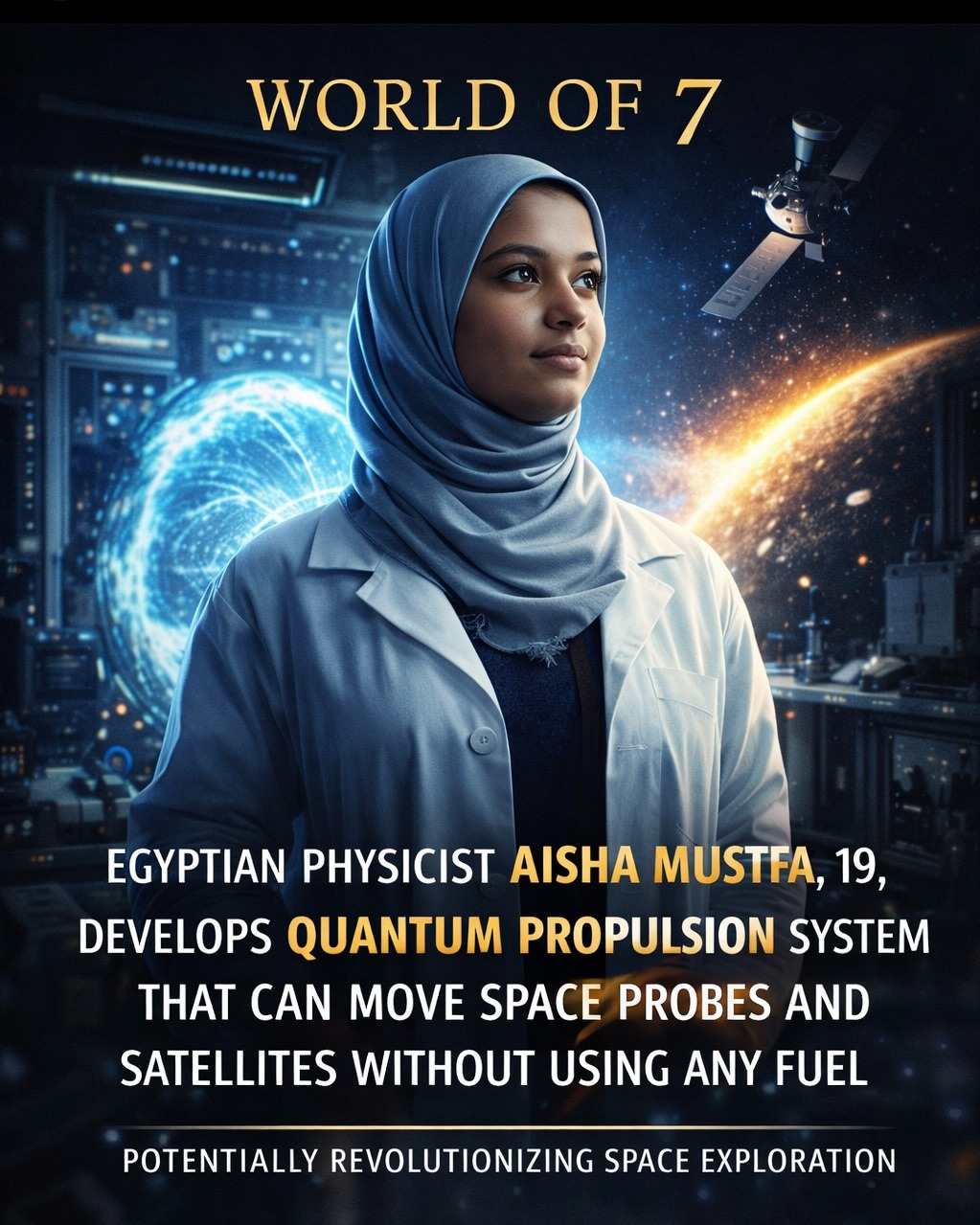
A bold idea emerging from a young mind is capturing global attention.
At just 19, Aisha Mustfa, an Egyptian physicist, is being widely discussed for developing a quantum-based propulsion concept—one that could, in theory, move satellites and space probes without relying on traditional fuel systems.
If realised, it would mark one of the most radical shifts in space technology in decades.
.
Beyond Rockets: Rethinking Motion in Space
For over half a century, space exploration has relied on one core principle:
Thrust requires fuel.
From early missions to modern launches, propulsion systems have depended on expelling mass to generate motion.
But emerging ideas within Quantum Physics are beginning to challenge that foundation.
Concepts involving:
Quantum field interactions
Vacuum energy dynamics
Non-traditional thrust mechanisms
…are opening the possibility of propulsion systems that may not require conventional fuel at all.
For over half a century, space exploration has relied on one core principle:
The idea associated with Aisha Mustfa suggests a future where:
Satellites could operate longer without fuel constraints
Space missions become lighter and more efficient
Deep-space exploration becomes more viable
While still conceptual, the implications are enormous.
The Scientific Reality
Extraordinary ideas require extraordinary validation.
At present:
No widely verified large-scale application exists
The physics behind such systems remains under active research
Similar concepts continue to be explored globally
But innovation has always started this way—
With bold thinking ahead of proof.
A New Voice from a New Generation
What makes this story resonate globally is not just the idea—
It’s who it comes from.
From Egypt, a country with a growing scientific and technological footprint, Aisha Mustfa represents a new wave of thinkers:
Young
Globally aware
Unafraid to challenge established norms
A Discovery That Changes Everything
Recent DNA and microscopic analyses of particles embedded in the fabric have revealed something remarkable:
The Shroud contains genetic traces from multiple regions across the globe.
Researchers have identified:
DNA linked to the Middle East
Strong genetic signatures connected to the Indian subcontinent
Biological traces from plants, animals, and human populations across continents
Some studies suggest a significant proportion of identifiable DNA may be tied to South Asian lineages, raising profound questions about the cloth’s history.
This is no longer just a European relic.
It may be a global artifact.
A Journey Hidden in Fabric
The implications are extraordinary.
Rather than originating and remaining in one region, the Shroud may have:
Passed through ancient Middle Eastern environments
Traveled along early trade networks reaching into Asia
Been handled by diverse populations over centuries
In this view, the Shroud becomes something far more dynamic:
A relic that moved — across cultures, continents, and time
Some researchers even speculate that the linen itself could be linked to high-quality ancient textile production beyond Europe, potentially connected to long-distance trade.
The Contamination Question
Yet the mystery is far from solved.
There is one critical challenge:
Centuries of contact.
The Shroud has been:
Touched by pilgrims
Examined by scientists
Exposed to environmental damage, including fire and restoration
This raises a key possibility:
The DNA found today may reflect everyone who has encountered the cloth — not necessarily its origin.
Even scientists acknowledge that isolating a single, original genetic source is extremely difficult.
Echoes of the Ancient World
If the evidence holds, the Shroud’s story may intersect with the great arteries of early civilisation:
Trade routes linking Asia, the Middle East, and the Mediterranean
Early forms of global exchange long before modern travel
Cultural and religious interactions spanning vast distances
It suggests a world far more connected than traditionally imagined.
And a relic that may have been part of that connection.
A Living Archive of Humanity
Whether authentic relic or historical enigma, the Shroud is taking on a new identity:
A biological record of human movement
A Living Archive of Humanity
Whether authentic relic or historical enigma, the Shroud is taking on a new identity:
A biological record of human movement
Within its fibers may lie:
Traces of ancient journeys
Evidence of cultural exchange
A microscopic map of human interaction across centuries
It transforms the debate.
This is no longer just about belief or authenticity.
It is about history itself.
Final Thought — A Mystery Reimagined
The Shroud of Turin remains one of history’s greatest mysteries.
But the question is evolving.
It is no longer simply:
Is it real?
But something far more intriguing:
Where has it been?
Because the answer may stretch from:
The Middle East
To South Asia
To Europe
Across centuries of human history.
And in that journey lies a possibility as powerful as the relic itself:
That history’s greatest mysteries were never confined to one place…
They were global from the very beginning.
The Bigger Question
If one artifact can carry the genetic fingerprints of multiple civilizations, what does that mean for others?
How many objects have travelled further than we realise?
How many histories have been simplified by geography?
And how often has the past been more global than we’ve been told?